Sangyeon Park (박상연)

I completed my M.S. in AI at GIST, advised by Prof. Kyung-Joong Kim.

My research has focused on ‘Plasticity Loss’ — the phenomenon where a model’s adaptability degrades when learning new data distributions during training. I have conducted research from the perspectives of reinitialization (FIRE), activation functions (AID), and weight regularization (SWR), and implemented and validated evaluation code across various continual learning and reinforcement learning benchmarks.

Please feel free to reach out for research collaborations, career opportunities, or any other questions!
Email  /  CV (Eng / Kor)  /  Google Scholar  /  LinkedIn  /  Github

profile photo
Publications
Selected / All

The Pokeagent Challenge: Competitive and Long-Context Learning at Scale
Seth Karten*, Jake Grigsby*, ..., Sangyeon Park, ..., Chi Jin.
Preprint '26
paper / challenge / summary
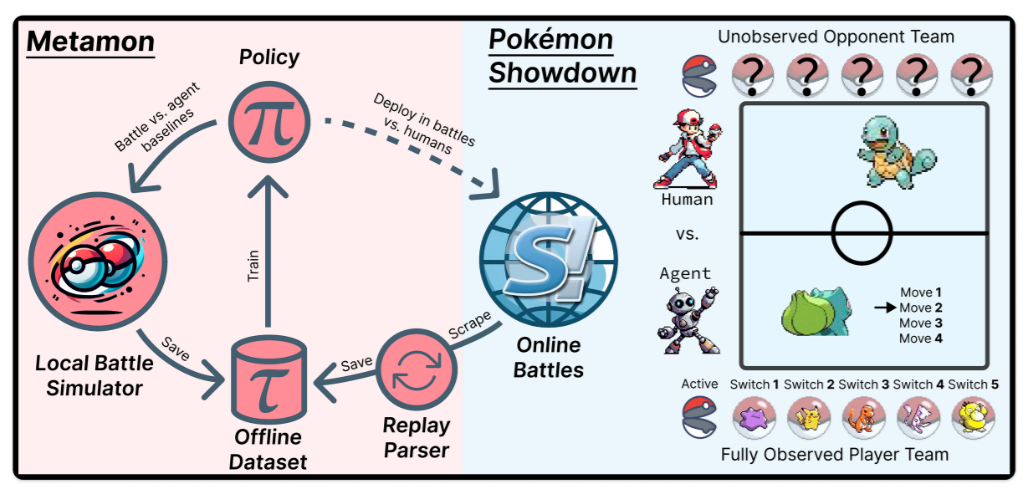
This paper reflects on our experience in the PokeAgent Challenge, a competition for building Pokémon battle agents. I participated as part of Team 4thLesson, which won second place in Track 1: Battling (Gen1OU). We fine-tuned the provided offline RL model by changing the activation function (LReLU → AID), replacing the optimizer (AdamW → Kron), and redesigning the self-play data collection strategy. Further technical details are available in Appendix E.1.3.


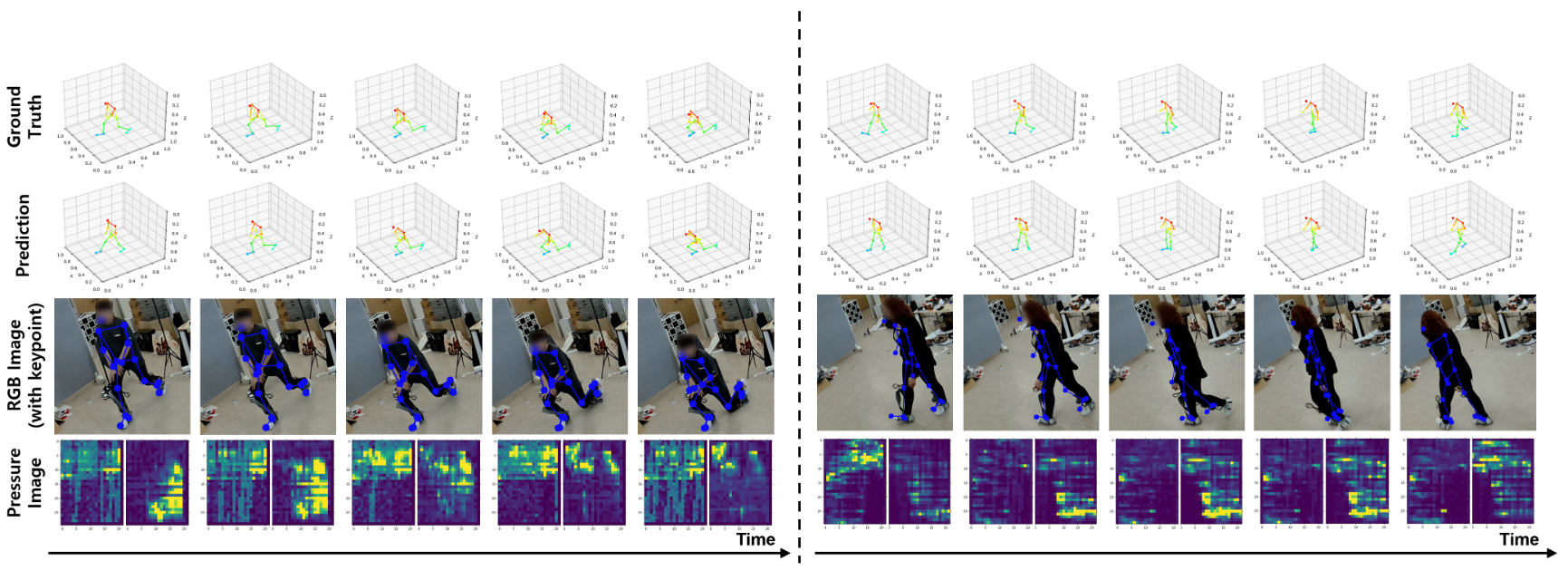
Shared Representation for 3D Pose Estimation, Action Classification, and Progress Prediction from Tactile Signals
Isaac Han, Seoyoung Lee, Sangyeon Park, Ecehan Akan, Yiyue Luo, Joseph DelPreto, Kyung-Joong Kim.
Preprint '26
paper / summary
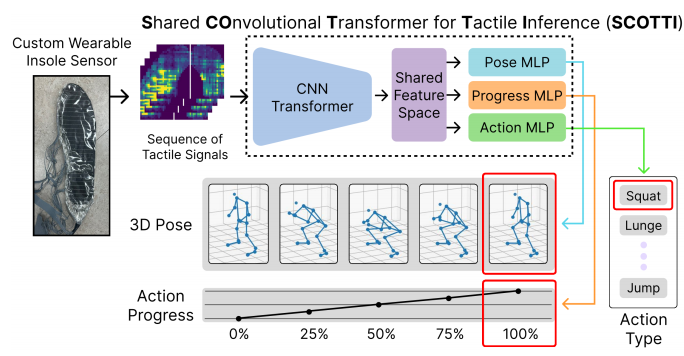
We propose SCOTTI, a unified model that jointly predicts 3D human pose, action category, and action progress from foot pressure signals. Instead of learning these three related tasks separately, SCOTTI learns them through a shared representation, leading to improved performance and a richer understanding of human motion from tactile signals alone. We also built a large-scale tactile-visual dataset from 15 participants and showed that this approach generalizes effectively across diverse actions and unseen subjects.


FIRE: Frobenius-Isometry Reinitialization for Balancing the Stability–Plasticity Tradeoff
Isaac Han, Sangyeon Park, Seungwon Oh, Donghu Kim, Hojoon Lee, Kyung-Joong Kim
ICLR '26, Oral
project page / paper / code / summary
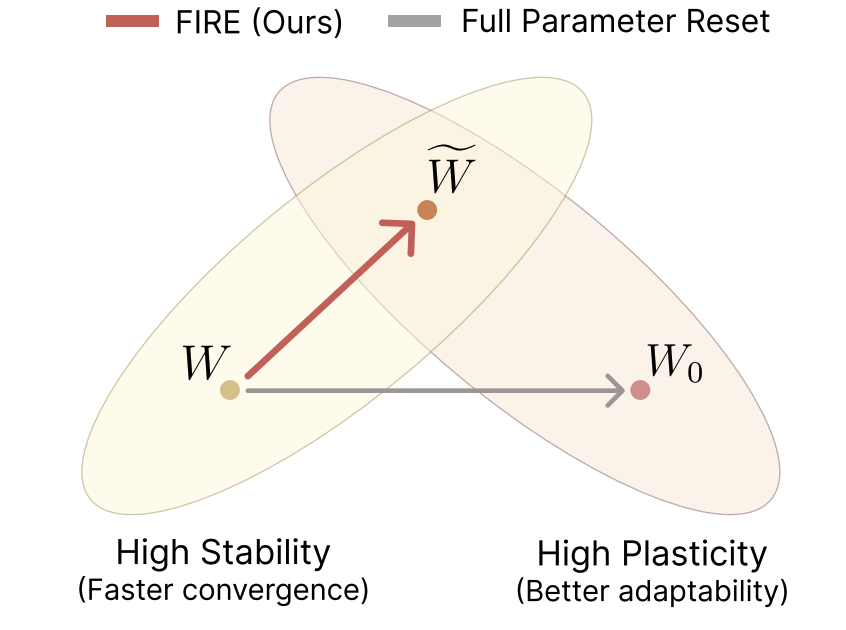
Existing reinitialization methods are often sensitive to hyperparameters: weak resets limit adaptation to new data, while strong resets can erase previously learned knowledge. We propose FIRE (Frobenius-Isometry REinitialization), a method that theoretically addresses the stability–plasticity tradeoff. FIRE also showed robust performance without hyperparameter tuning across a variety of settings with shifting data distributions, including vision, language, and reinforcement learning.


Activation by Interval-wise Dropout: A Simple Way to Prevent Neural Networks from Plasticity Loss
Sangyeon Park, Isaac Han, Seungwon Oh, Kyung-Joong Kim
ICML '25
paper / summary
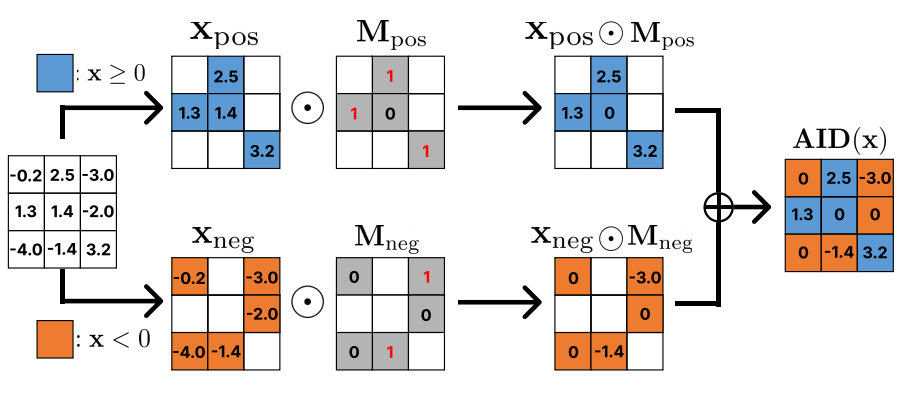
We investigate the hypothesis that Dropout can worsen Plasticity Loss, and propose AID (Activation by Interval-wise Dropout), which addresses this issue by integrating the idea into the activation function itself. We theoretically show that AID injects linearity into the model, and demonstrate that it preserves plasticity more effectively than existing baselines across a range of continual learning and reinforcement learning settings.

Note. This paper is currently affected by a Google Scholar indexing issue, where it has been incorrectly merged with Simon Park’s Generalizing from SIMPLE to HARD Visual Reasoning: Can We Mitigate Modality Imbalance in VLMs? and Seohong Park’s Flow Q-Learning.


Recovering Plasticity of Neural Networks via Soft Weight Rescaling
Seungwon Oh*, Sangyeon Park*, Isaac Han, Kyung-Joong Kim.
Preprint '24
paper / summary
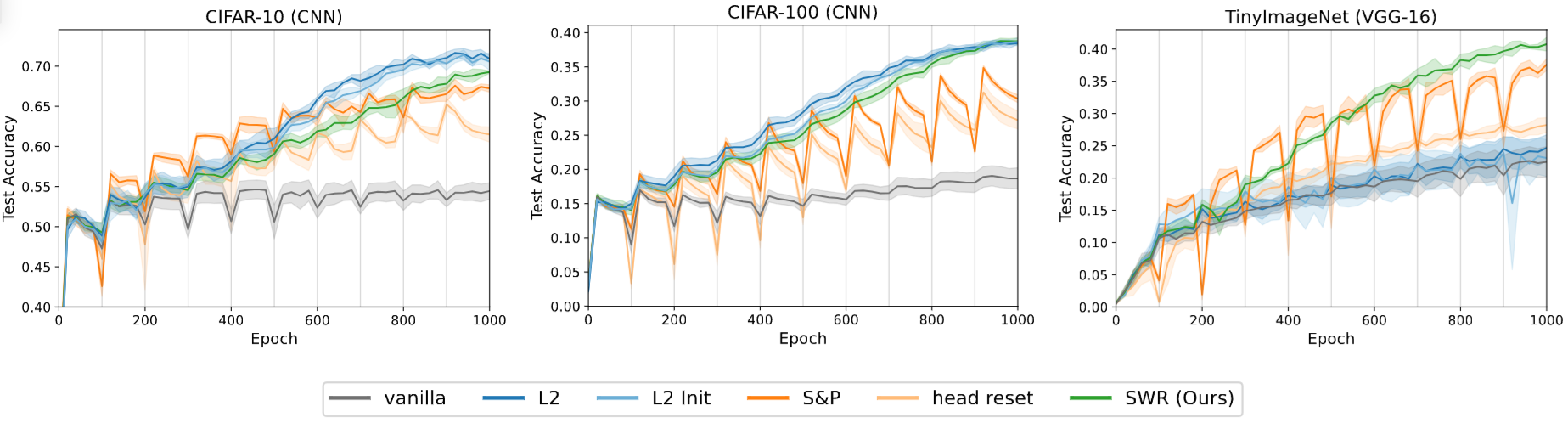
While Plasticity Loss can arise from multiple factors, one major cause that has been identified is unbounded weight norm growth. To mitigate this issue, we propose a weight regularization method called SWR (Soft Weight Rescaling) and validate it in continual learning settings. SWR was especially effective at preserving plasticity in large vision models such as VGG-16.


Smart Insole: Predicting 3D Human Pose from Foot Pressure
Isaac Han, Seoyoung Lee, Sangyeon Park, Ecehan Akan, Yiyue Luo, Kyung-Joong Kim.
NeurIPS '24 (Workshop on Touch Processing: From Data to Knowledge)
paper / summary
We propose a method for predicting 3D human pose using only foot pressure data. While previous tactile pose estimation approaches were often limited to fixed sensing environments such as floor-mounted sensors, we implemented the system in the form of wireless smart insoles, enabling use without spatial constraints. Using real-world foot pressure data paired with vision-based labels, we show that smart insoles alone can estimate human pose and movement with strong accuracy.


*: Equal contribution
†: Equal advising
Experiences
GIST
GIST (Gwangju Institute of Science and Technology) 2023.09 – 2026.02
M.S. in AI Convergence (GPA: 4.08 / 4.5) Gwangju, Korea
Thesis: Activation by Interval-wise Dropout (Advisor: Kyung-Joong Kim)
Soongsil University
Soongsil University 2017.03 – 2023.02
B.S. in Software / Mathematics (GPA: 4.26 / 4.5) Seoul, Korea

Template based on Isaac Han's website.